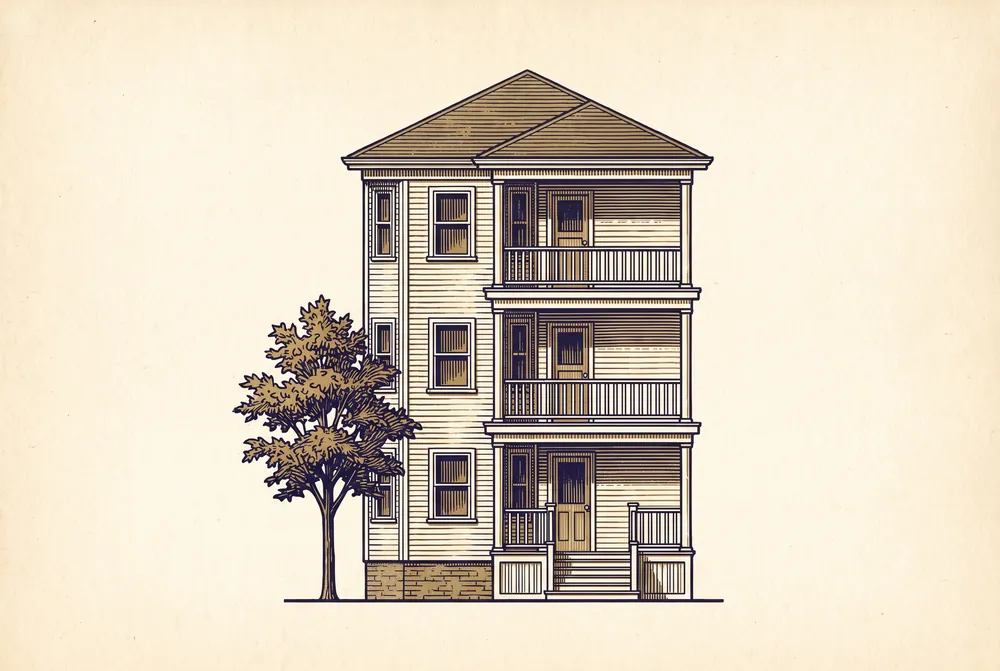
There is a specific conversation I have four or five times a year. Somebody has found a three-decker, they have taken the asking rents from the listing, they have subtracted them from a payment they estimated on a national website, and the answer came out to a number so small it looked like the house was free.
It is never free. But it is often good, and the difference between those two sentences is worth understanding before you write an offer.
The lender does not count the rent you were told
Most agency programs credit roughly 75% of market or lease rent toward what you qualify for. The missing quarter is the underwriter’s allowance for vacancy and maintenance. It is not negotiable and it is not personal.
Which rent gets used matters too. If there are leases, the lender generally uses the lower of the lease rent and the appraiser’s market rent. If the units are empty, it uses the appraiser’s rent schedule — a separate form the appraiser fills in, which frequently disagrees with what the seller’s spreadsheet says. I have seen it come in both above and well below.
A seller’s rent roll is a marketing document. The appraiser’s rent schedule is the one the lender reads.
The self-sufficiency test, which is not about you
On some three- and four-unit programs there is an additional test: the credited rents alone must cover the entire monthly payment — principal, interest, tax, insurance and mortgage insurance. Your income is irrelevant to it. You either pass or you do not.
Two-unit purchases are generally not subject to it, which is a large part of why a two-family is an easier file than a three-family even though it feels like the same kind of house. If you are looking at three or four units, this is the first thing to check, and the calculator on this site runs it.
What the spreadsheet leaves out
- Reserves after closing. Three- and four-unit files usually want several months of full payments still sitting in an account after you have paid for everything. It is a common reason a file that looked fine on income stalls at the end.
- One boiler. Many three-deckers have a single heating system for the whole building, which means the owner pays for heat and the tenants have no reason to close a window in January.
- Separate meters, or the absence of them. Ask before the inspection. Retrofitting electrical separation is not a weekend.
- The February vacancy. Nobody moves in February in Rhode Island. A unit that goes empty in winter can stay empty for two months at a rent you did not plan to skip.
- Insurance. A three-family costs meaningfully more to insure than a single family, and the quote you were shown was probably for a single family.
Why people do it anyway
Because it works. Living in one unit of a building whose other units pay most of the mortgage is the most reliable way anybody in this state has ever turned a normal income into a house. It has been true here for over a century, which is why so many of these buildings exist in the first place.
The version that goes wrong is the one where somebody used the listing’s numbers, skipped the reserve requirement, and found out about the self-sufficiency test in week five. The version that goes right is the one where all of that was on a page before the offer went in.
Written for a demonstration. Nadia Botelho is an invented broker and this article is example content showing what a real practitioner’s writing would occupy. It describes how these things generally work; it is not advice, and no figure in it is a quote.